Kitchen Exhaust Cleaning in Milton and Halton Hills
Kitchen Exhaust Cleaning in Milton and Halton Hills is a duct-by-duct job, and the duct itself is never the same building twice. A hood on Georgetown's or Acton's main street usually feeds a run that climbs through an older upper floor nobody mapped when it was installed. A hood in a new Milton plaza feeds a straight riser shared with the tenant next door. Milton Hood Cleaning opens both types at every access panel, degreases each section to bare metal, and checks the NFPA 96 grease limit of 0.078 inches along the entire path from collar to fan.
Old main street versus new plaza: two different kitchen exhaust cleaning jobs
A building on Georgetown's Main Street or Acton's Queen Street was rarely designed around a commercial kitchen. The duct got routed through whatever space existed above: an old apartment floor, a storage attic, a gap between joists never meant to carry a shaft. Nobody kept the drawings, access panels are often missing, and the crew traces the run by hand before pricing the job.
A hood in a newer Milton plaza feeds a riser engineered on purpose, often sized for two or three tenants up to one shared rooftop fan. The panels are there and the run is straight, but a shared riser raises a different problem: the quote has to state which section belongs to which kitchen, because grease inside a shared shaft does not respect a lease line.
Commercial kitchen exhaust cleaning: horizontal run, riser and access panels
Three parts make up the duct system between a hood and a rooftop fan. The horizontal run begins at the collar on top of the hood and travels across the ceiling void toward the shaft. Airflow slows the moment it passes the collar, which is why grease drops out of suspension there and packs against the outside wall of every elbow.
The riser carries the airstream vertically up to the fan curb. Grease condensing on the riser wall does not stay where it lands: it slides down under its own weight and pools at the base, so a riser can look spotless from the roof while the heaviest buildup sits out of sight at its foot.
Access panels are gasketed openings that make each section reachable for cleaning and measuring. A section with no panel gets flagged at the walk-through and priced as its own labour line. Canopy, filters and plenum are covered on the hood cleaning services page, and the fan itself on the exhaust fan repair and installation page.
Hood vent cleaning versus a full kitchen exhaust cleaning service
What most operators call a hood vent is the duct, so cleaning the vent means opening the duct.
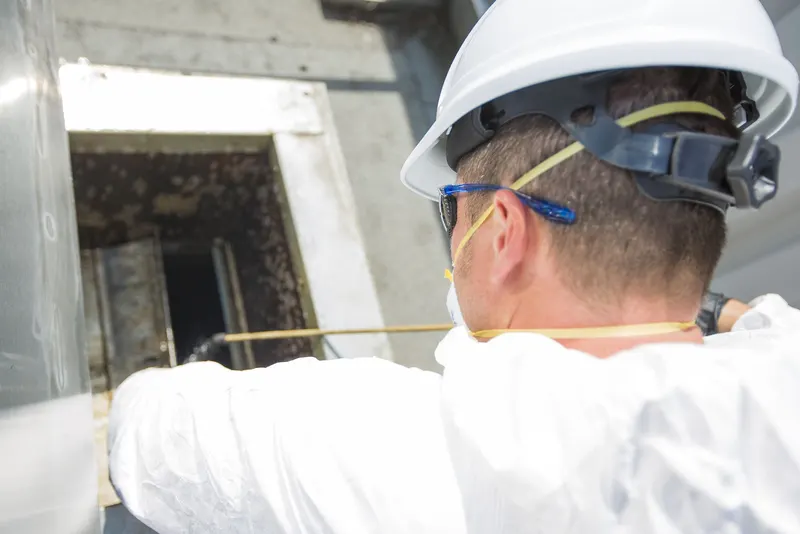
A vent cleaning quote that only mentions the filters has stopped at the hood. If the vent behind the hood is what actually needs attention, a proper quote names the run length, the riser height and the panel count before a crew ever shows up. Which words describe which part of this one system is explained in plain terms on the services page.
Grease exhaust cleaning: hood-only vs full-system on the certificate
What the paperwork covers depends on how much of the duct was actually opened, not on how the invoice reads.
| Question an inspector asks vs the answer | Hood-only | Full-system |
|---|---|---|
| Was the run behind the hood opened? | No, the collar was reached from underneath only. | Yes, every access panel came off and each length was photographed and dated. |
| Was the riser foot checked? | Not included in the scope. | Yes, the pooled layer removed with before-and-after photos on file. |
| Where did the 0.078 inch check happen? | Canopy and plenum surfaces only. | Collar, every elbow, riser foot and fan inlet. |
| What does the signed certificate list? | One hood assembly. | Every section cleaned, plus any section not accessible and why. |
How the standard sets cleaning frequency by cooking volume, and what a certificate does and does not assert, is covered on the NFPA 96 page.
Tracing an undocumented run on Georgetown and Acton main streets
A duct behind an older Georgetown or Acton storefront was often installed once, decades ago, and never revisited. The crew traces the path with a camera and a tape measure before quoting a single dollar, because missing panels decide most of the labour on a job like this. A run through an upper-floor void may need two or three new access points cut and gasketed before cleaning starts, each priced as its own line and agreed before any cutting happens. The payoff is a complete, current map of a duct that previously had none, so the next visit takes a fraction of the time the first one did.
New-build plaza risers: a shared shaft still needs a first clean
Plazas built in the past few years around Willmott, Ford, Coates and Hawthorne Village typically route two or more food tenants into one shared riser. The engineering is modern and the panels sit where the drawings say, which makes the physical job faster than an old main-street trace. What still needs attention is the paperwork: a shared shaft means each kitchen's branch duct up to the junction is a separate scope, priced and certified on its own. A brand-new riser is not a clean riser: grease condenses from the first day a tenant cooks, so a plaza that opened this year is already due for the same first-clean baseline as a system decades old.
Grease trails on the roof: what a Milton or Halton Hills operator should watch for
A dark streak running from the fan curb across the membrane means grease has travelled the full length of the duct and is now leaving the building as liquid.
The rooftop walk-through exists to catch exactly this sign before it becomes a roof-membrane repair bill. A trail behind a business-park cafeteria in the Derry Green Business Park, or behind a plaza kitchen on Steeles Avenue, points to an overloaded run and riser upstream of the fan. The duct gets cleaned first, starting at the collar and working outward, with the fan itself and its rooftop containment handled on the exhaust fan repair and installation page.
How much does kitchen exhaust cleaning cost in Milton in 2026?
A single-hood kitchen up to ten feet is priced from $585 per visit, and a multi-hood kitchen with two to four canopies from $995 per visit. Larger systems and shared risers are quoted on site after a free walk-through, with a written quote back within 24 hours.
On a full-system visit, the duct itself sets the labour: run length, elbow count, riser height and how many access panels already exist all move the number. Cutting new panels is priced as its own line, and solid-fuel systems are quoted per job after an inspection rather than off a flat rate.
Next step: call 289-401-1377 or request a written quote. Mention whether the kitchen shares a riser with another tenant and whether the duct has ever been opened before. All three services run through the services page.
Kitchen exhaust cleaning services in Milton: frequently asked questions
Does an older Georgetown or Acton building cost more to clean?
Often, yes. A duct run through an undocumented upper floor takes longer to trace and may need new access panels cut before cleaning starts, and that extra time shows up as a separate labour line on the quote, agreed before the work begins.
Who pays for a shared riser in a new Milton plaza?
The building owner covers the shared riser under most commercial leases. Each tenant is responsible for its own hood and branch duct up to the point it joins the shared shaft, and the two scopes are quoted and certified separately.
How many access panels does a typical duct run need?
Enough to reach every section: one near the collar, one at each change of direction, and one at the base of the riser. A run that has never been serviced commonly has one panel installed, or none at all.
Is the 0.078 inch grease limit different inside the duct than at the hood?
No. NFPA 96 sets one limit for the whole system. A depth that would fail an inspection at the plenum fails just as badly at a duct elbow or at the foot of the riser.
Does kitchen exhaust cleaning cover a home range hood duct?
No. Milton Hood Cleaning services commercial kitchens only, and a residential range hood duct is outside that scope entirely. The commercial kitchen types this crew serves are listed on the who we serve page.